
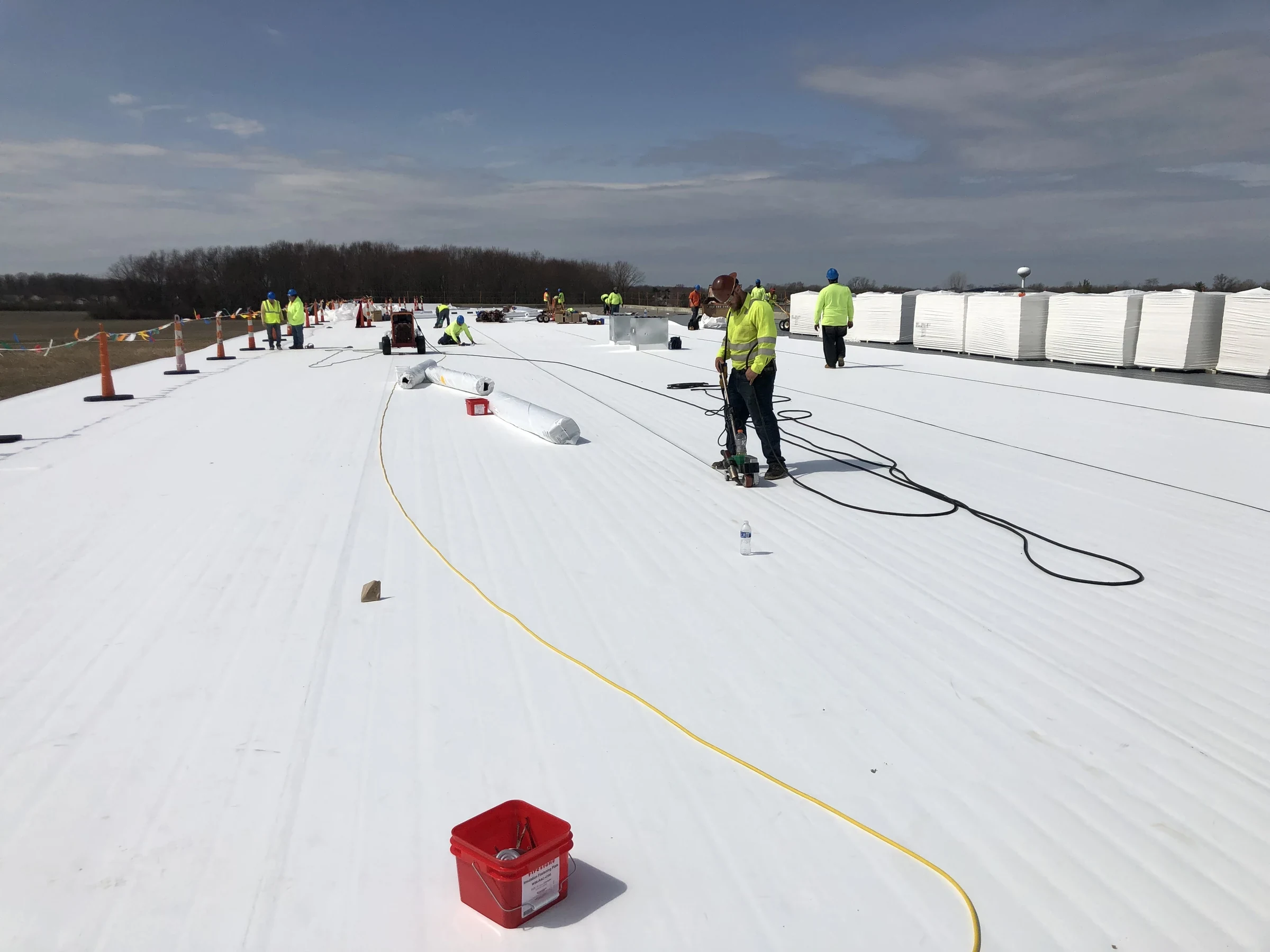
PVC Roofing Systems in Fayetteville, NC
PVC membrane for Fayetteville restaurants, grocery, and grease-exposed rooftops. Weld quality, plasticizer retention, and where PVC beats TPO locally.
PVC Roofing Systems in Fayetteville, NC
PVC membrane for Fayetteville restaurants, grocery, and grease-exposed rooftops. Weld quality, plasticizer retention, and where PVC beats TPO locally.
PVC for Roofs That See Grease, Exhaust, or Chemical Contact
PVC membrane earns its spec on a narrower set of buildings than TPO or EPDM, but on the right roof nothing else in the single-ply category performs as well. If a roof sits under kitchen exhaust, near a grease-trap vent, or downwind of chemical fume discharge, PVC's chemical resistance is the deciding factor - not price, not color, not attachment method.
Why Grease and Chemical Exposure Change the Calculation
TPO and EPDM both degrade faster than PVC when exposed to petroleum-based oils and greases, which is exactly what settles onto a roof surface downwind of a rooftop kitchen exhaust fan or a grease-trap vent stack. Fast-food and grocery buildings along the retail corridors near the base - Bragg Boulevard, Skibo Road, Owen Drive - almost always have at least one exhaust point discharging some amount of grease-laden air onto the roof, and over years that residue can soften or degrade a membrane that isn't formulated to resist it.
PVC's chemistry holds up under that exposure in a way the other single-plies don't, which is why we push back when a value-engineered bid tries to swap PVC for TPO on a restaurant reroof to save cost. It's a false savings if the membrane starts breaking down at the exhaust zone within a few years.
How PVC Welds Differ From TPO Welds
Both membranes get hot-air welded, but the underlying chemistry is different - PVC is a plasticized vinyl compound, not a thermoplastic olefin, and it welds at a different temperature range with different tolerance for welder speed and overlap. A crew that's spent years welding TPO doesn't automatically weld PVC correctly on day one; the heat settings and probe testing routine both change. We treat PVC welding as its own trained skill on the crew, not an assumed carryover from TPO experience.
Quality control on a PVC job means probe-testing every seam as it's completed, not spot-checking a sample after the fact. A weak PVC seam behaves the same as a weak TPO seam - it opens under wind or ponding stress - so the field verification discipline matters just as much here.
Plasticizer Retention Over Time
Older PVC formulations had a reputation for going brittle over time as plasticizers migrated out of the sheet, which is part of why some contractors still default away from PVC out of habit. Modern PVC membranes use plasticizer formulations that retain flexibility far longer than the sheets that earned that old reputation, and manufacturers have decades of field performance behind the current generation of products. We spec current-generation PVC and don't treat the old brittleness concern as still relevant to what's actually being installed today.
UV and Heat Performance Through Sandhills Summers
PVC's light, typically white or gray surface reflects solar heat similarly to white TPO, which keeps rooftop temperatures down through the long, humid Fayetteville summer. Combined with its chemical resistance, that reflectivity is one more reason PVC often wins the spec on restaurant and grocery buildings, where rooftop exhaust equipment already runs hot and the last thing the membrane needs is added solar heat gain stacked on top of it.
Where This Shows Up Locally
- Fast-food and quick-service restaurants along the retail corridors near Fort Liberty
- Grocery stores with rooftop kitchen or bakery exhaust systems
- Healthcare buildings with chemical fume exhaust from sterilization or lab equipment
- Manufacturing facilities with solvent or oil-based process exhaust
- Buildings adjacent to a restaurant tenant's shared rooftop exhaust discharge
Reroofing a Restaurant Without Closing the Kitchen
A restaurant can rarely afford to close during a reroof, so we sequence the work to keep the kitchen exhaust fan running and vented throughout, protecting the fan curb and ductwork while the surrounding membrane gets replaced in stages. Grease trap access and roof drain locations near the kitchen get mapped before demolition starts so a crew never accidentally blocks an active vent path mid-shift.
On grocery and multi-tenant buildings with a restaurant as one of several tenants, we isolate that tenant's exhaust zone as its own phase, working around their service hours rather than the building's overall schedule, so the one operation most exposed to disruption gets prioritized instead of squeezed in last.
Questions on PVC Roofing
Is PVC more expensive than TPO?
Generally yes, per square foot, though the gap has narrowed in recent years. On a roof exposed to grease or chemical contact, the added cost usually pays for itself by avoiding early membrane degradation that a standard TPO wouldn't resist.
Can PVC be installed over an existing EPDM roof?
PVC is not compatible with direct contact against EPDM due to plasticizer migration between the two membrane types, so any recover situation involving a switch from EPDM to PVC needs a separator layer or full tear-off. This is one of the first things we check before proposing a recover.
Does PVC handle ponding water differently than TPO?
Both membranes tolerate incidental ponding reasonably well, but neither is a substitute for proper drainage design. Keeping drains and scuppers clear of pine debris matters just as much on a PVC roof as any other system.
How long do modern PVC roofs typically last with maintenance?
Manufacturers publish warranty terms that vary by thickness and attachment method, and current-generation PVC has a strong field record when seams are welded correctly and maintenance stays current. We review specific warranty options during the proposal stage rather than quoting a blanket figure.
Will PVC discolor from grease exposure even if it doesn't degrade?
Some surface staining near exhaust points is common over time and is largely cosmetic rather than a performance issue, though heavy buildup should still be cleaned periodically to keep drainage paths clear.