
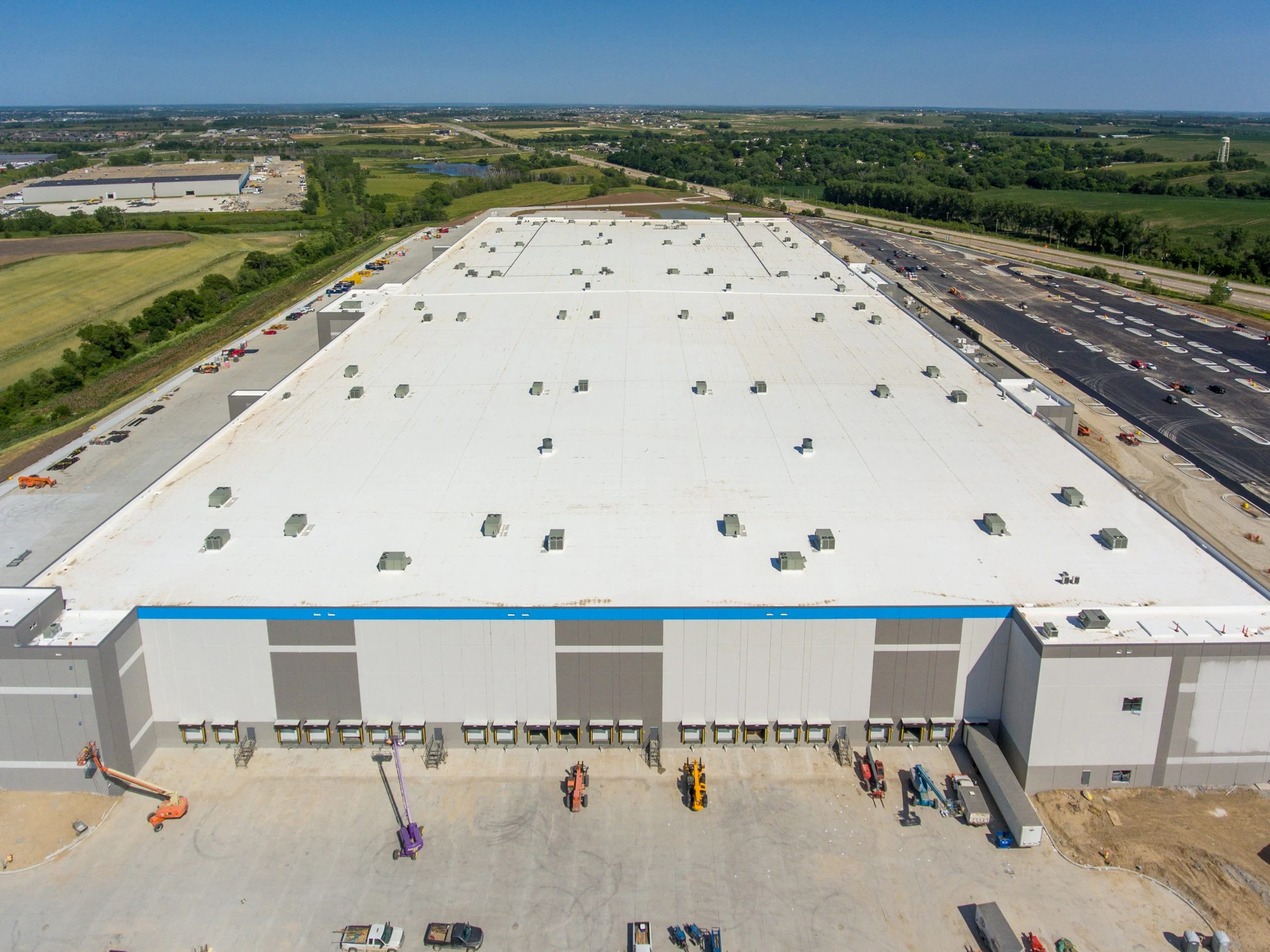
Warehouse Roofing in Fayetteville, NC
Warehouse roofing in Fayetteville, NC: dock-door sequencing, wide-span drainage, and plant-specific systems for I-95 corridor distribution and processing facilities.
Warehouse Roofing in Fayetteville, NC
Warehouse roofing in Fayetteville, NC: dock-door sequencing, wide-span drainage, and plant-specific systems for I-95 corridor distribution and processing facilities.
Warehouse Roofs Built for the I-95 Distribution Corridor
The stretch of I-95 and I-74 running through Dunn, Lumberton, Benson, and St. Pauls carries some of the heaviest warehouse and distribution activity in this part of the state, alongside manufacturing plants in Sanford and food processing operations in Clinton, Raeford, and Tar Heel. These buildings run around the clock, and a roof project on one of them has to respect a dock schedule that never really stops.
Dock Doors That Keep Moving Through the Project
A distribution warehouse lives and dies by dock door throughput, and a re-roof or repair that blocks even one or two doors for an extended stretch shows up immediately in a facility's shipping numbers. We stage material drops and equipment away from active dock doors and sequence roof sections so the number of doors taken out of service at any one time stays as small as possible.
Coordinating with the warehouse's own logistics team on shift schedules matters here too, since a facility running three shifts has far less downtime to work around than a single-shift operation.
Wide Clear-Span Roofs Over Racking and Product
Warehouse roofs in this corridor span wide open distances over racking systems and inventory that can be extremely sensitive to water, particularly at food processing plants like the ones in Clinton and Tar Heel where product contamination from a roof leak is a serious problem, not merely an inconvenience. We treat drainage design and ponding prevention as a priority on these wide spans, since standing water over a roof deck above product storage is a bigger risk than the same ponding over an empty office building.
Roof structural loading matters more on these wide spans too, since a warehouse with heavy rooftop equipment or a history of ponding sometimes carries deflection that a standard visual inspection from the ground would never catch.
Forklift and Material Handling Traffic Below the Work Zone
Warehouse floors below the roof stay busy with forklift traffic, conveyor systems, and constant staging of product, all of which continues while we're working above. We coordinate directly with the facility's operations manager on which floor zones are active below any given roof section, since falling debris risk changes the calculus for scheduling compared to a retail or office building with lighter floor traffic.
We rope off and mark the floor area directly beneath any active work zone as an added precaution, even when the section above is otherwise considered low-traffic, since a warehouse floor plan can shift day to day as product gets moved and restaged.
- General distribution and fulfillment warehouses
- Food processing and cold-storage plants
- Manufacturing and light-industrial buildings
- Truck terminal and cross-dock facilities
- Third-party logistics and freight consolidation centers
- Bulk storage and agricultural product warehouses
Industrial Roof Systems Matched to Plant Operations
Food processing plants carry different rooftop conditions than a standard distribution warehouse, with steam, grease, and washdown exposure from processing operations affecting membrane life differently than a dry-goods facility. We evaluate the specific plant environment before recommending a system, since a roof detailed for a standard dry warehouse won't necessarily hold up the same way over a poultry or pork processing operation.
Manufacturing plants like the ones in Sanford add their own variable, with process exhaust and rooftop chemical storage venting that needs specific flashing and material compatibility considerations most standard warehouse roofs never encounter.
Storm Response for Buildings That Never Stop Shipping
A distribution or manufacturing operation along this corridor doesn't pause shipping because a storm is coming, which means roof damage during severe weather needs a fast response to keep product and equipment protected. We prioritize emergency tarping and dry-in on active warehouse and plant roofs specifically because downtime here carries a direct cost in missed shipments, not simply repair expense.
We keep emergency materials staged with facilities we service regularly along this corridor, since a same-day tarp response matters more to a shipping operation than it does to a building that can simply wait until Monday.
Skylights, Smoke Vents, and Older Rooftop Penetrations
A number of the older industrial buildings along this corridor were built with skylight panels or smoke vent assemblies that predate current membrane systems, and those penetrations tend to be where age-related leaks show up first. We check skylight seals and smoke vent flashing as a standard part of any warehouse inspection, since these older penetrations often get overlooked in favor of the larger, more obvious membrane field.
Where a skylight or vent assembly has reached the end of its useful life, we look at whether replacing it as part of a broader roof project makes more sense than patching around a fixture that's likely to keep failing.
Some operators along this corridor run more than one facility between Dunn, Lumberton, and Sanford, and roof condition at one site doesn't tell you much about the others if they were built in different decades or have different equipment loads. We report condition and recommended timing facility by facility, giving an operations team the information needed to prioritize capital spending across the whole network rather than reacting site by site as leaks show up.
We also flag when a repair at one facility points to a design or installation pattern likely to repeat at a sister site constructed around the same time, so an operator can get ahead of a recurring issue instead of paying for the same emergency call at every location one at a time.
Questions Warehouse and Plant Managers Ask Us
Can dock doors stay in operation during roof work?
Yes, we sequence sections to minimize how many doors are out of service at once and coordinate around your shift schedule.
How do you handle drainage over racking and inventory?
We prioritize drainage design and ponding prevention on wide clear-span roofs, especially where product below is sensitive to moisture.
Do food processing plants need different roof systems than standard warehouses?
Often yes, since steam, grease, and washdown exposure affect membrane differently than a typical dry-goods facility.
What's your response time for storm damage on an active facility?
We prioritize emergency tarping and dry-in on operating warehouses and plants, since downtime there has an immediate shipping cost.
Can you coordinate around three-shift operations?
Yes, we work directly with your operations team to find the actual quiet windows a continuously running facility has.