
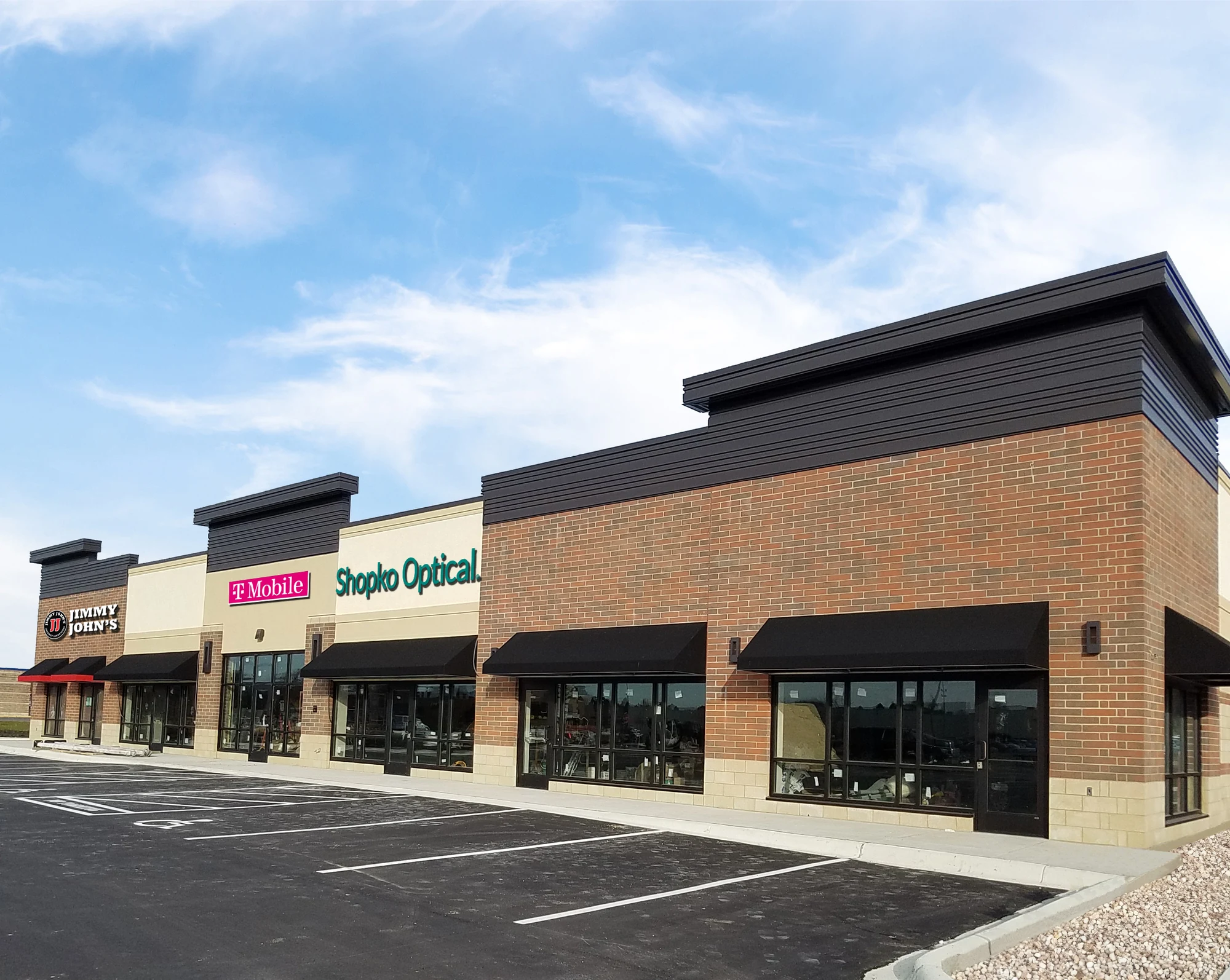
Multi-Tenant Retail Strip Roofing in Fayetteville, NC
Multi-tenant strip center roofing in Fayetteville, NC: scheduling around tenant hours, restaurant exhaust details, and leak tracing across shared roof planes.
Multi-Tenant Retail Strip Roofing in Fayetteville, NC
Multi-tenant strip center roofing in Fayetteville, NC: scheduling around tenant hours, restaurant exhaust details, and leak tracing across shared roof planes.
One Roof, Multiple Leases: Coordinating Strip Center Repairs
Strip centers along Skibo Road, Ramsey Street, and Bragg Boulevard usually share one roof across six, ten, or more separate tenants, each running a different business with a different schedule and a different owner asking questions. We treat that coordination as part of the job, not a side issue that gets figured out on the fly.
Sequencing Work Around Different Tenant Hours
A nail salon, a restaurant with a grease exhaust hood, and a phone repair shop under the same roof don't open or close at the same time, and they don't tolerate noise or dust the same way either. We map tenant hours before we schedule tear-off, working over the businesses that are closed or slow first and saving the loudest phases for hours when foot traffic is lightest across the whole center.
Restaurant tenants get particular attention because of grease exhaust penetrations and make-up air units, which need to stay functional through service hours or the kitchen can't legally operate.
Explaining Scope to a Property Manager, Not Ten Business Owners
Most strip center roof work is contracted through a single property manager or owner even though ten different businesses sit underneath, and common-area charges tied to roof repairs often become a point of confusion for tenants. We keep our documentation clear enough that a property manager can explain the scope and cost allocation to tenants without guessing at what was actually done.
We also flag any lease-related distinctions we notice during the walk-through, since some tenant leases assign responsibility for rooftop equipment maintenance differently than the base building lease assigns roof membrane responsibility, and that gap is worth surfacing before a dispute over who pays for what.
One Membrane, Many Different Rooftop Penetrations
A single strip center roof might carry restaurant exhaust hoods, standard HVAC curbs, satellite mounts for a phone store, and vent stacks for a hair salon, all penetrating one continuous membrane. Every one of those penetrations is a place water can find its way in, and a leak over one tenant's ceiling often traces back to a detail near a completely different tenant's rooftop equipment. We trace leaks across the whole roof plane rather than assuming the wet ceiling tells you exactly where to look.
That tracing process usually starts with a full rooftop survey rather than going straight to the spot above the reported leak, since the actual point of entry is often several feet away from where the water eventually shows up on a ceiling tile.
- Restaurant and quick-service tenant spaces
- Personal care and salon tenants
- Retail and specialty shop tenants
- Medical and dental satellite offices in strip formats
- Financial services and insurance office tenants
- Fitness and personal service studios
Grease, Vents, and Exhaust Details That Take Extra Care
Restaurant tenants in strip centers create some of the toughest roofing details in this market. Grease-laden exhaust air degrades standard membrane faster than ordinary rooftop conditions, so we look closely at flashing and membrane condition around every restaurant exhaust penetration, not only the obvious wear spots elsewhere on the roof.
Where a new restaurant tenant is moving into a space previously occupied by a different type of business, we recommend evaluating the existing membrane around any new exhaust penetration before the kitchen build-out finishes, since it's far easier to reinforce that detail before equipment is installed than after.
Storm Season Repairs When One Leak Affects Several Businesses
Because the roof is continuous across tenants, a single storm-damaged section can put water into two or three unrelated businesses at once. We prioritize emergency tarping across the whole affected section immediately, then work with the property manager on a repair sequence that gets every affected tenant dry, not simply the one that called first.
Communication across affected tenants matters here too, since a business owner dealing with water damage wants to know someone is actively working the problem, even if their specific unit isn't first in the repair sequence.
Using Vacant Units as Staging Space
Strip centers in this market rarely sit at full occupancy year-round, and a vacant unit can actually make a roof project easier rather than harder. When a property manager has an empty unit available, we use the roof space directly above it for material staging and equipment access first, keeping that activity away from occupied tenants for as much of the project as possible.
That approach doesn't eliminate the need to work over occupied spaces eventually, but it buys time to sequence the noisiest, messiest phases before crews have to move over a business that's open and serving customers.
Strip center rooflines often carry mounted signage, awning attachments, and parapet caps that belong to individual tenants rather than the building as a whole, and those elements need to come down and go back up correctly during a re-roof. We document the condition and mounting of tenant signage before touching it and coordinate reinstallation so a tenant's storefront doesn't lose its signage or awning function during the project.
Older centers along corridors like Ramsey Street sometimes have signage mounts installed years ago by different tenants using different hardware, and we take extra time on those roofs confirming each mount is sound before we build a new membrane detail around it, rather than assuming uniform construction across the whole roofline.
Questions Strip Center Owners and Managers Ask Us
Do you coordinate scheduling with every tenant individually?
We work through the property manager on overall scheduling, then confirm specific timing directly with tenants whose spaces are most affected, like restaurants with exhaust penetrations.
Can a leak over one tenant actually start somewhere else on the roof?
Yes, water often travels along the deck before showing up as a stain, so we trace the roof plane rather than just patching under the visible spot.
How do you handle restaurant exhaust hoods during re-roofing?
We detail and flash around them carefully and schedule the closest work to avoid disrupting kitchen operating hours.
Can documentation be split out for cost-allocation purposes?
We provide scope and cost documentation clear enough for a property manager to allocate charges appropriately among tenants.
What happens if a storm damages the roof over several tenants at once?
We tarp and stabilize the entire affected section first, then sequence permanent repairs so every tenant gets back to dry conditions.